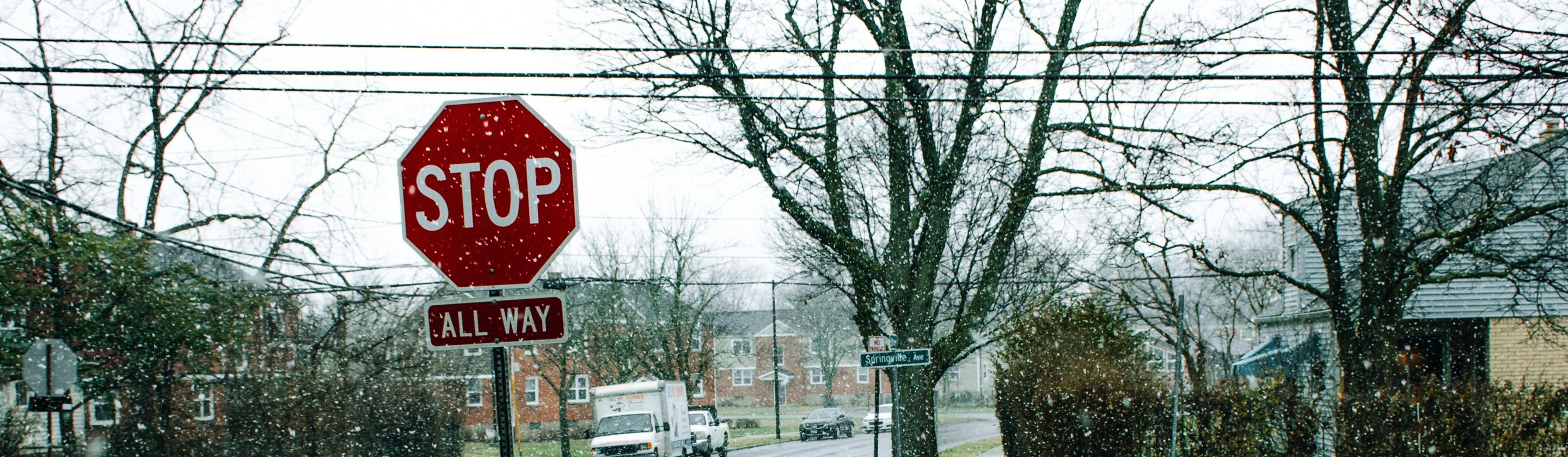
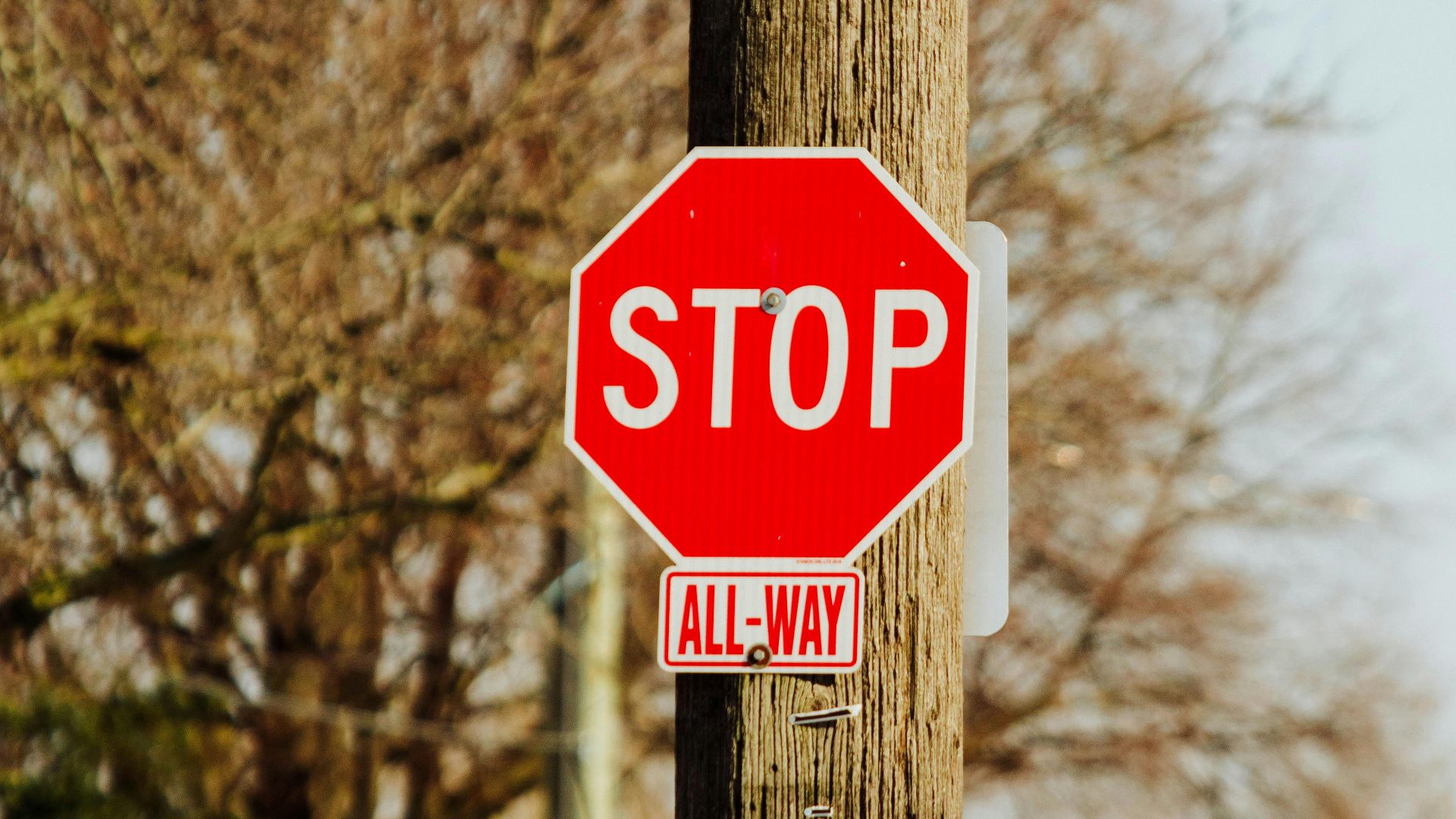
The four-way stop is one of the few places in modern life where strangers are asked to self-govern with no referee, no signal light, and no way to communicate beyond eye contact and vague hand gestures through a windshield. It runs on written law and unwritten agreement, and the gap between those two things is where all the interesting behavior lives. Most drivers could not recite the actual rules if asked, and most navigate the intersection just fine anyway, which says something revealing about how much of social order rests on intuition rather than knowledge.
Approximately 40 percent of all motor vehicle crashes in the United States occur at intersections. The four-way stop was designed to reduce the severity of those collisions by eliminating speed differentials and forcing everyone to pause. It works, mostly, not because drivers are well-versed in traffic code, but because the intersection activates something older and more reliable than legal knowledge. It activates social instinct.
The Rules That Nobody Reads
The formal hierarchy at a four-way stop is simple enough. The vehicle that arrives first proceeds first. When two vehicles arrive simultaneously, the one on the right has the right of way. When two vehicles arrive from opposite directions at the same time and one is turning left, the turning vehicle yields to straight-through traffic. These rules are codified in traffic law across all fifty states, and a meaningful portion of licensed drivers could not accurately recite all three of them.
This doesn't cause the chaos you'd expect. A 2003 National SAFE KIDS Campaign survey found that roughly 44 percent of observed motorists violated stop signs, including 37 percent who rolled through and 7 percent who did not slow down. And yet four-way stops, despite being governed partly by guesswork and partly by whoever makes the most confident move first, tend to function. The explanation has less to do with traffic law and more to do with the informal protocols drivers have collectively developed to fill the gaps.
The most important of these is arrival sequencing, which most drivers track accurately even when they couldn't explain the rule. You know, without thinking carefully, roughly who got there when, across all four corners simultaneously. The brain does this automatically because it's a social calculation, the same one that tells you who was next in the checkout line. The four-way stop is a fairness problem at its core, and humans are extraordinarily well-calibrated for fairness problems.
The Negotiation Layer
Above the formal rules sits a second layer of communication that drivers have developed because the rules alone are insufficient. Eye contact is the primary currency. Catching someone's gaze and giving a slight nod confirms a shared understanding in real time in a way a written statute cannot. The brief wave, the small forward gesture that means go ahead, is a close second. Neither is codified anywhere. Both are universally understood.
The wave matters more than it should, given that it takes about half a second and costs nothing. When someone waves you through, they're doing something slightly larger than moving traffic along. They're briefly acknowledging that the two of you are in this together, operating by the same understood logic. The driver who accepts the wave and rolls through without so much as a nod has broken something small but real, and the driver who offered it always notices.
The four-way stop also produces its own version of negotiation failure: the double-wave standoff, where two drivers simultaneously signal each other to proceed, both hesitate, both start moving, then both stop again. This resolves on the third attempt through exaggerated gesturing and someone finally just going. The standoff is uncomfortable precisely because both parties were trying to be polite, and the social contract broke down through an excess of deference rather than aggression, which is somehow more costly.
The Violations That Grate
Nothing at a four-way stop produces the specific, quiet fury of being skipped. You arrived first, or arrived simultaneously with someone to your left who should therefore yield, and they simply went. They may have misjudged the timing. The emotional response is instant and disproportionate to the actual delay, which is measured in seconds, because it registers not as a traffic inconvenience but as a social violation. The implicit compact was broken.
The rolling stop produces a different irritation. Technically a traffic violation, it signals that the driver doesn't take the intersection seriously enough to fully participate in its logic. You stopped all the way. You respected the ritual. They did not. This asymmetry feels like a mild slight even when it results in no practical harm, because the four-way stop is not only a traffic control device. It is a small demonstration that strangers can briefly organize themselves by agreeing to follow the same rules at the same time.
That implicit demonstration is what makes violations feel personal. The four-way stop asks every driver to extend brief trust to three strangers in a situation where nobody is in charge. Most of the time, it works. The arrival sequencing is tracked, the right-of-way is respected, the waves are exchanged, and four vehicles pass through a potential conflict with nothing more than a mild choreography of deceleration and acceleration. Nobody enforced it. It happened because everyone involved, usually without knowing the formal rules, understood what the situation required and did it anyway.