 Unknown photographer on Wikimedia
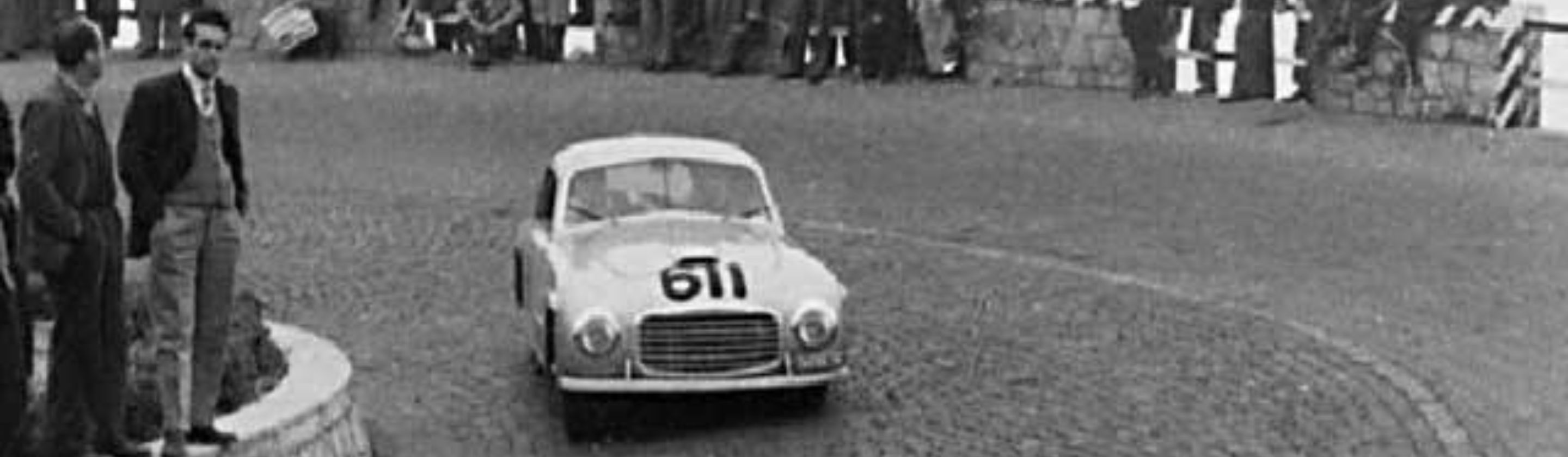
The Mille Miglia ran a thousand miles from Brescia down to Rome and back, on ordinary Italian roads, past villages where people stood on the pavement to watch cars go by at 150 miles an hour. There were no barriers and no run-off, and in most places no police line either. Spectators leaned into the road for a better look and stepped back when they heard an engine coming, which worked until it did not.
It ran from 1927 to 1957 and produced the kind of driving that has no modern equivalent, partly because no sanctioning body on earth would permit it now. The race ended on an afternoon in May, about thirty miles from the finish. What happened there closed open-road racing in Italy for good.
A Thousand Miles With The Roads Still Open
Entrants left Brescia one at a time through the night, each car numbered by its start time. Moss carried 722 in 1955 because he rolled off the ramp at twenty-two minutes past seven. Farm traffic was cleared where possible and livestock were supposed to be kept off the route. Crowds were not, and photographs from the era show children sitting on walls a few feet from the racing line.
The 1955 edition produced a record that has never been beaten, for the good reason that nobody has been allowed to try. Stirling Moss and his navigator Denis Jenkinson covered the course in a Mercedes 300 SLR in ten hours and seven minutes, averaging just under 98 miles an hour for the entire distance. Jenkinson had written pace notes onto a roll of paper eighteen feet long, wound onto a homemade aluminum spool he turned with a thumbwheel. He called out corners he could not see, at speeds where one wrong note would have killed them both.
None of this was a secret. A crash at Bologna in 1938 killed ten people, seven of them children. Mussolini's government suspended the race for a year before letting it return. Drivers understood the arithmetic and entered anyway. The crowds kept standing where they had always stood, close enough to touch the cars as they went past.
May 12, 1957
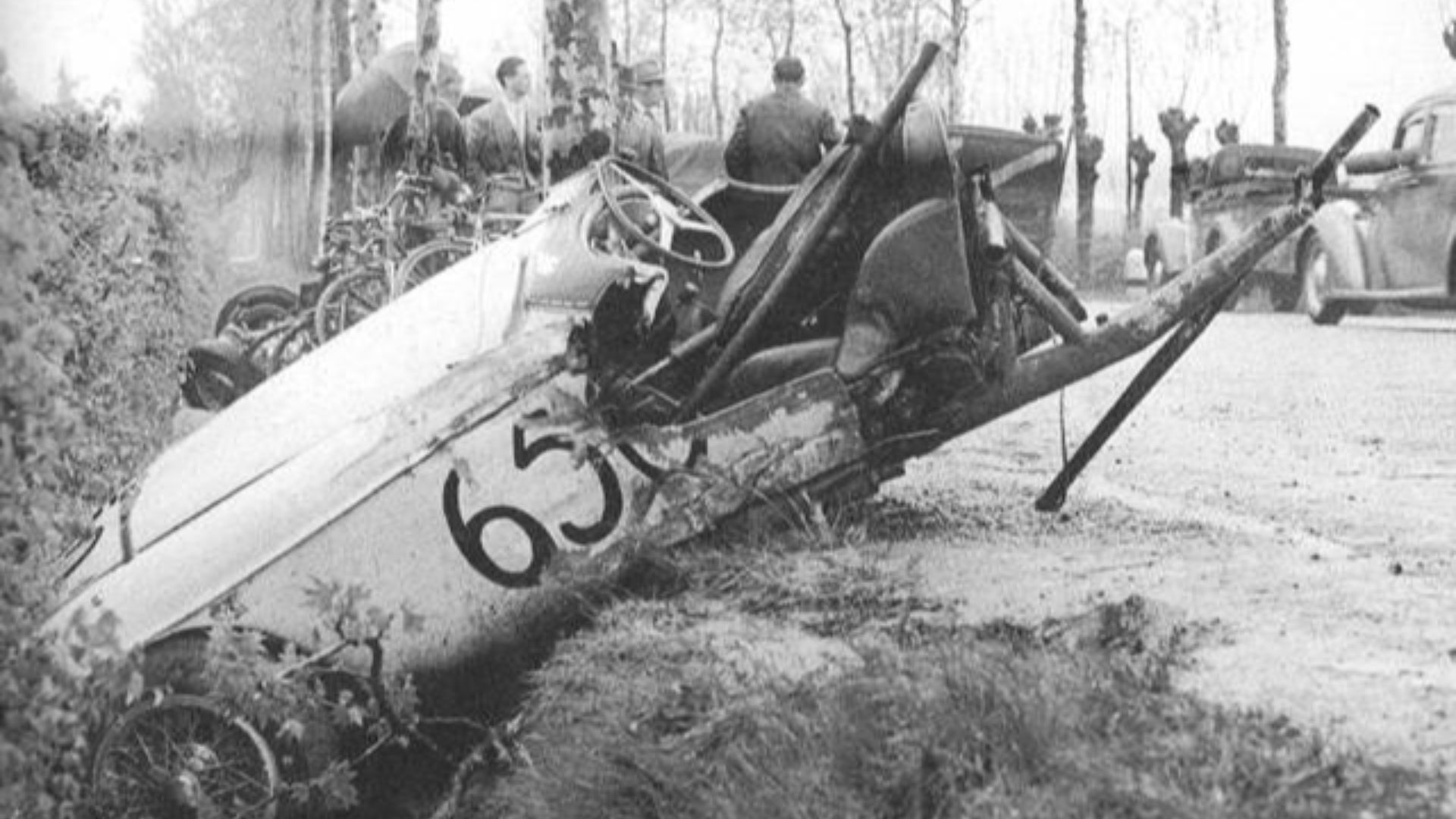
Alfonso de Portago was a Spanish aristocrat who had come to motor racing from bobsled and steeplechase riding. He was running third in a Ferrari 335 S near the village of Guidizzolo, about thirty miles from the finish. A tire failed at around 150 miles an hour. The car left the road and went through the people lining it before coming apart.
De Portago died, along with his co-driver Edmund Nelson and nine people who had come out to watch. Five of them were children. Piero Taruffi won the race that afternoon at the age of fifty. He had promised his wife he would retire if he ever won it, and he kept the promise. Photographs from the scene ran in newspapers across Europe within two days. The Italian reaction was immediate and furious, and the Vatican newspaper joined the calls to end the race.
Enzo Ferrari and the Belgian tire manufacturer Englebert were charged with manslaughter, on the argument that the tires had been unsuitable for the loads the car was putting through them. The case ground on for four years before a court dismissed it in 1961. The Mille Miglia itself was finished long before that, cancelled outright, with Italy banning racing on open public roads.
What Replaced It
The timing mattered. Two years earlier at Le Mans, a car had gone into the crowd and killed more than eighty people. Europe was already rethinking what it allowed near a racetrack. Switzerland banned circuit racing outright after that and did not lift the ban for six decades. Guidizzolo arrived while the argument was still live and settled it.
A version of the Mille Miglia came back in 1977 and still runs every May, with entry fees that reach five figures. Cars built before 1957 retrace the original route, driven at legal speeds, with the result decided by how precisely a crew hits timed checkpoints rather than by who gets there first. It is a parade with a stopwatch attached, and roughly four hundred crews enter it.
Purists sometimes dismiss the modern event as a costume party. They are right that it bears little resemblance to what Moss and Jenkinson did, but that was the condition for bringing it back at all. The original race killed more than fifty people across its twenty-four editions, many of them spectators standing close to the road because that was simply how the event was watched.