On April 29, 1899, Belgian engineer Camille Jenatzy became the first person to drive a car faster than 100 km/h, and he did it in an electric vehicle. Racing along a straight stretch of road at Achères, outside Paris, he covered a flying kilometer in just 34 seconds, averaging 105.88 km/h (65.79 mph). His battery-powered record breaker was called La Jamais Contente, or "The Never Satisfied."
Electric power was a practical choice in 1899. Electric motors delivered strong torque, and early gasoline engines struggled to match their performance over a short distance. The record attempts used a flying kilometer, meaning the cars were already moving when the clock started, so the results measured speed rather than acceleration. There was a commercial incentive, too. Both men competing for the record manufactured and sold electric vehicles, making every attempt a chance to advertise their products. Jenatzy had grown up in a family involved in the rubber trade before entering the electric car business himself.
The Duel That Started It
Count Gaston de Chasseloup-Laubat set the first recognized land speed record in December 1898, driving an electric Jeantaud powered by a single 36-horsepower motor. He covered the measured kilometer in 57 seconds, averaging 39.2 mph. A cyclist had already managed the same distance a second faster. Jeantaud built electric taxis for Paris, so the count was setting records in what was essentially a modified commercial vehicle.
On December 18, Camille Jenatzy challenged the count through a letter to La France Automobile, giving him a month to beat his time on the same road. They met at Achères on January 17, with Jenatzy going first and reaching 41.4 mph. Chasseloup-Laubat answered with 43.7 mph, although the competition pushed his Jeantaud hard enough that its motor burned out roughly 200 meters short of the finish.
Jenatzy returned ten days later and pushed the record to 49.9 mph. Chasseloup-Laubat answered on March 4 in a redesigned Jeantaud, now fitted with a pointed nose, tapered tail, and streamlined undertray to reduce air resistance. The changes paid off. He reached 57.6 mph, cutting six seconds from Jenatzy's time and showing just how much a car's shape mattered at high speeds.
Building La Jamais Contente
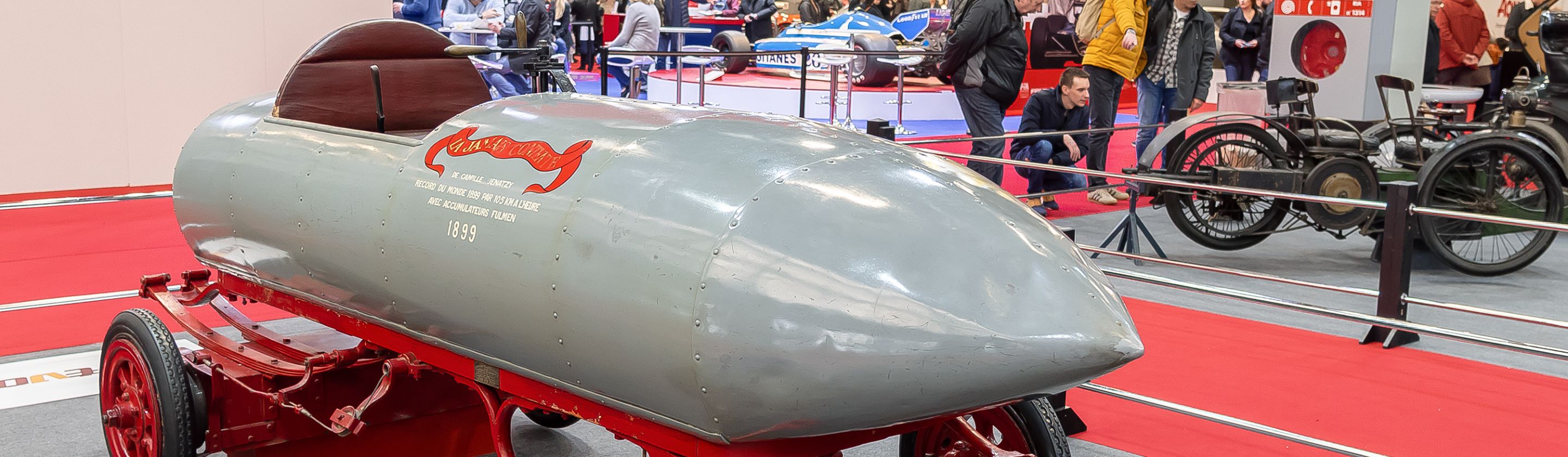
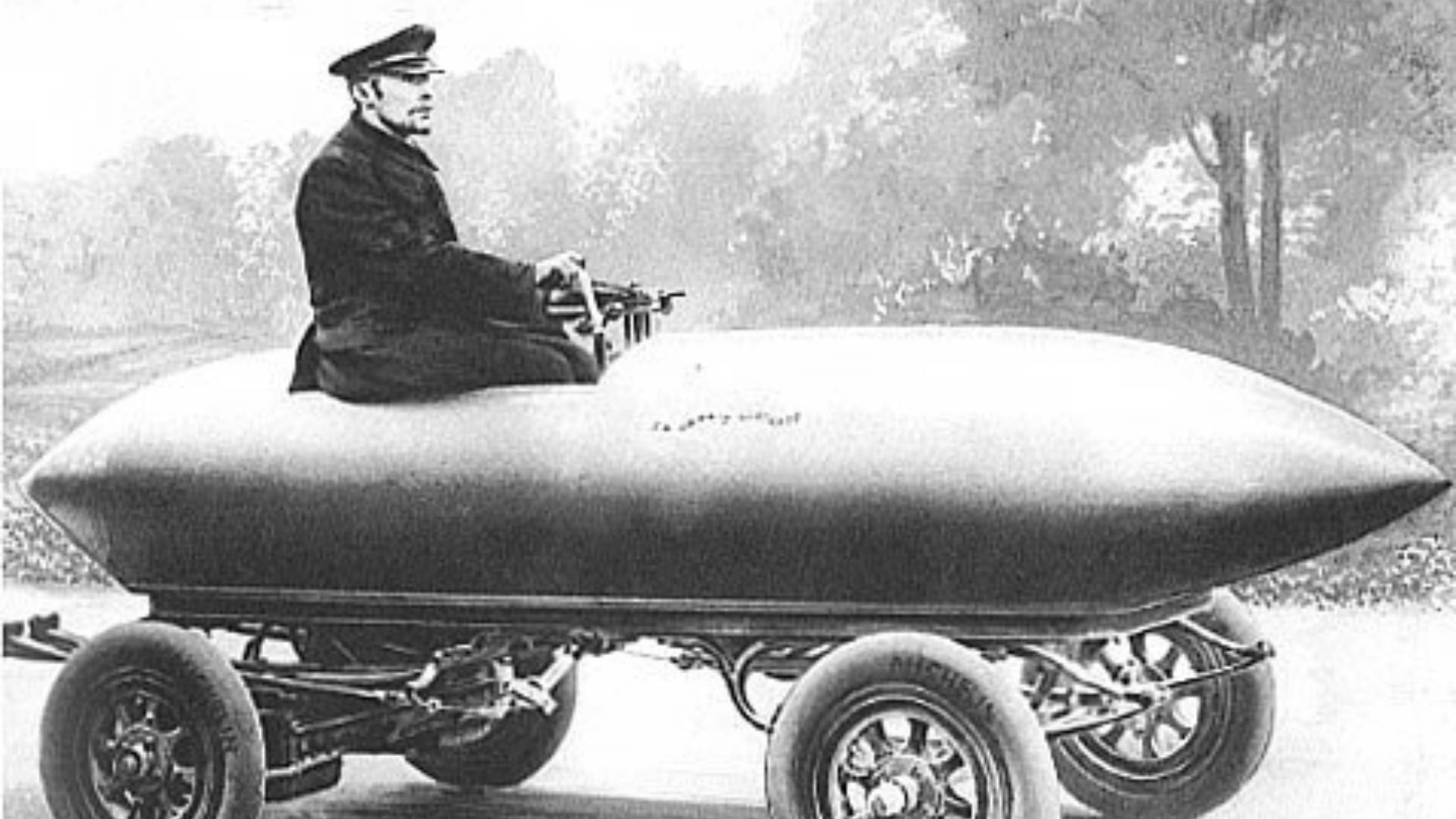
Modifying a touring car had reached its limit, so Jenatzy commissioned something built for nothing but the record. The body was a torpedo designed by Léon Auscher of the Rothschild coachworks, skinned in a light alloy called partinium. The recipe mixed aluminum with tungsten and magnesium. Nothing else on the road looked remotely like it.
Underneath sat a plain chassis on semi-elliptic leaf springs, with small wood-spoked wheels wearing Michelin pneumatic tires. Postel-Vinay supplied the motors, one per rear wheel, each turning at 900 rpm and driving through a chain for something near 68 horsepower combined. The machine weighed about 1,450 kilograms, most of that in batteries.
The aerodynamics were half-finished, which the photographs make obvious. The chassis and running gear hung exposed below the smooth body, and Jenatzy sat bolt upright in an open cockpit with his head and shoulders in the airstream. A steering wheel stood high in front of him, well clear of the hull. Whatever the torpedo shape gained, the driver sitting on top of it gave back. An attempt on the first of April came to nothing because the timekeepers were not ready.
What The Record Meant
The 29 April run made Jenatzy the first person to drive a car past 100 kph, and the mark stood for about three years. Officials from the Automobile Club de France were there to time and certify it. Achères had been chosen because a road ran straight and level through farmland there, and the same stretch hosted every run of the duel. He was known as Le Diable Rouge for the color of his red beard, and the name stuck to him longer than the record did.
Batteries lost the argument shortly afterward. Range was the problem no amount of streamlining could fix, and a car needing a recharge after a few kilometers had nowhere to go on an open road. Léon Serpollet took the record in a steam car in 1902 at 120.8 kph, and William K. Vanderbilt raised it again that August in a gasoline Mors. Jenatzy moved to internal combustion himself and won the Gordon Bennett Cup in 1903 driving a Mercedes. No electric car has held the outright record since.
La Jamais Contente survives, and it sits in the national car museum at Compiègne north of Paris. The car looks small in person, and the cigar-shaped hull reads as oddly modern next to vehicles built a decade later. The museum keeps it among a collection of carriages, some of them built two centuries before the car was.