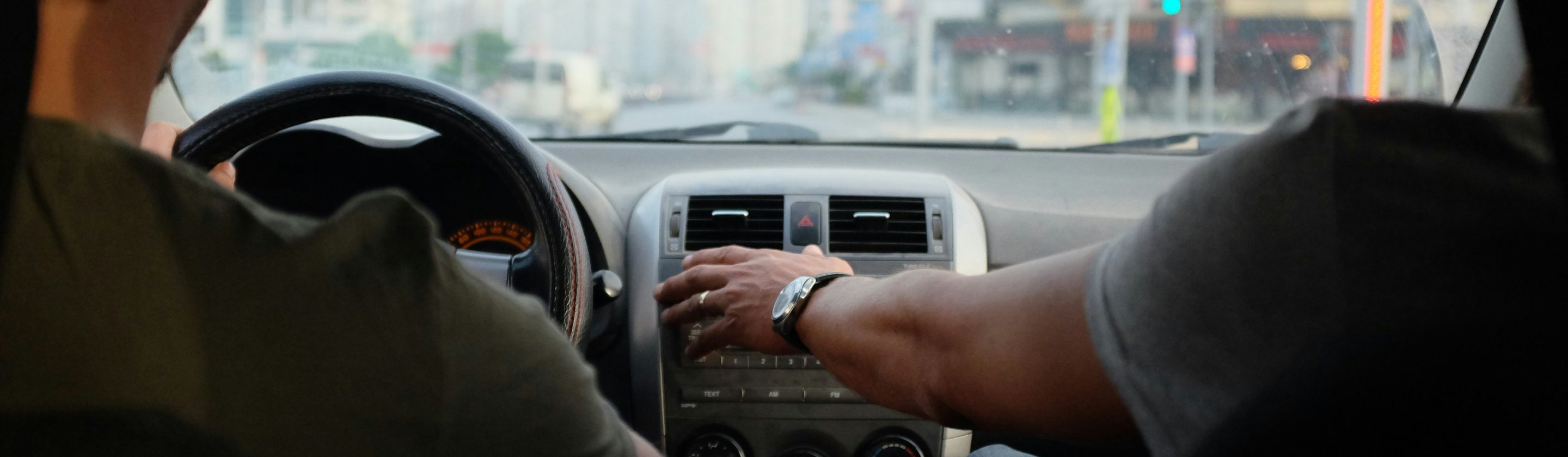

There's a moment that happens in almost every car, on almost every road trip, that no amount of good intentions can fully prevent. Someone reaches for the radio. Someone else makes a face. A negotiation begins that has no clean resolution, only a temporary ceasefire that lasts until the next commercial break. The station gets changed, or it does not, and either way someone is quietly seething in the passenger seat with their arms crossed and their eyes on the window.
We talk about music taste as though it is a personal quirk, something charming and individual, like preferring a window seat or taking coffee without sugar. What it actually is, in a car, is a power struggle conducted entirely through playlists and presets. The radio button is not just a button. It is a small declaration of who gets to define the mood, the memory, and the entire emotional texture of the next two hundred miles.
Why the Car Is Different
Music sounds different in a car, and not just acoustically. There is something about being enclosed together, moving at speed through a landscape, that makes every sonic choice feel more loaded than it would at home. At home, you can leave the room. In a car, you are committed. The song playing when you crossed the state line is the song you will associate with that trip for the rest of your life, and everyone in the vehicle knows this on some wordless level, which is why nobody gives up the aux cord without a fight.
The stakes are also generational in a way that catches people off guard. A parent who grew up with classic rock and a teenager who has spent three years building a carefully curated indie playlist are not just disagreeing about tempo or lyrics. They are disagreeing about identity, about whose emotional world gets to fill the shared space for the next hour. The same argument happens between partners, between friends, between siblings on a six-hour drive to a family reunion that nobody was particularly excited about in the first place. The music becomes a proxy for everything else.
Road trip playlists have become a genuine cultural artifact in a way that almost nothing else has. Streaming data consistently shows that playlist creation spikes sharply ahead of long weekends and major holidays, with Spotify reporting tens of millions of road trip playlists created on their platform annually. People spend real time on these. They sequence tracks, consider transitions, and build something they genuinely care about, which makes it all the more devastating when the driver skips your song forty-five seconds in without comment.
The Unwritten Rules Nobody Agrees On
Every family, every friend group, every couple that has ever taken a road trip together has developed a set of informal rules about the radio that nobody explicitly negotiated but everyone is expected to follow. The driver usually controls the music, except when they do not. The passenger gets veto power over truly offensive choices, except when that is contested too. Long trips develop a rotation system that breaks down somewhere around hour three, and then someone pulls out their phone and the whole arrangement quietly collapses.
There are also the sins that cannot be forgiven. Talking over a good song. Changing the station during the bridge. Skipping something before it has had thirty seconds to prove itself. Connecting your phone mid-trip and immediately dismantling the playlist someone spent forty minutes building. Each of these transgressions carries a weight that feels disproportionate until you consider that inside a car, the music is one of the only things any passenger can meaningfully influence. The road is fixed. The weather is fixed. The traffic is fixed. The playlist is the one variable, which is why everyone fights over it so hard.
The loudest arguments often happen not over genre but over repetition. Asking to play the same song twice on a single trip is a social risk that most experienced road trip travelers have learned to assess carefully before taking. Some cars have a one-repeat rule. Some have no tolerance for it at all. Others have a specific passenger, usually the same one every time, who can request anything twice and everyone just accepts it because the alternative is a conversation nobody wants to have somewhere outside of Amarillo.
What We Are Actually Fighting About
Strip away the specific songs and the arguments about volume, and what is left is something fairly simple. A car is one of the few places where adults are physically stuck together with no exits and no distractions beyond the road. The music fills that space in a way that feels personal, because it is. Whoever controls the sound controls the atmosphere, and controlling the atmosphere feels, however briefly, like controlling something real.
The radio button argument is really an argument about whose experience matters more right now, whose nostalgia gets to be honored, whose taste is worth accommodating. Most of us are too polite to have that conversation directly. So instead we argue about whether to skip to the next track, or whether classic rock really holds up, or why anyone would voluntarily listen to this, until eventually someone gives in and peace returns, fragile and temporary, lasting exactly until the next song starts.