
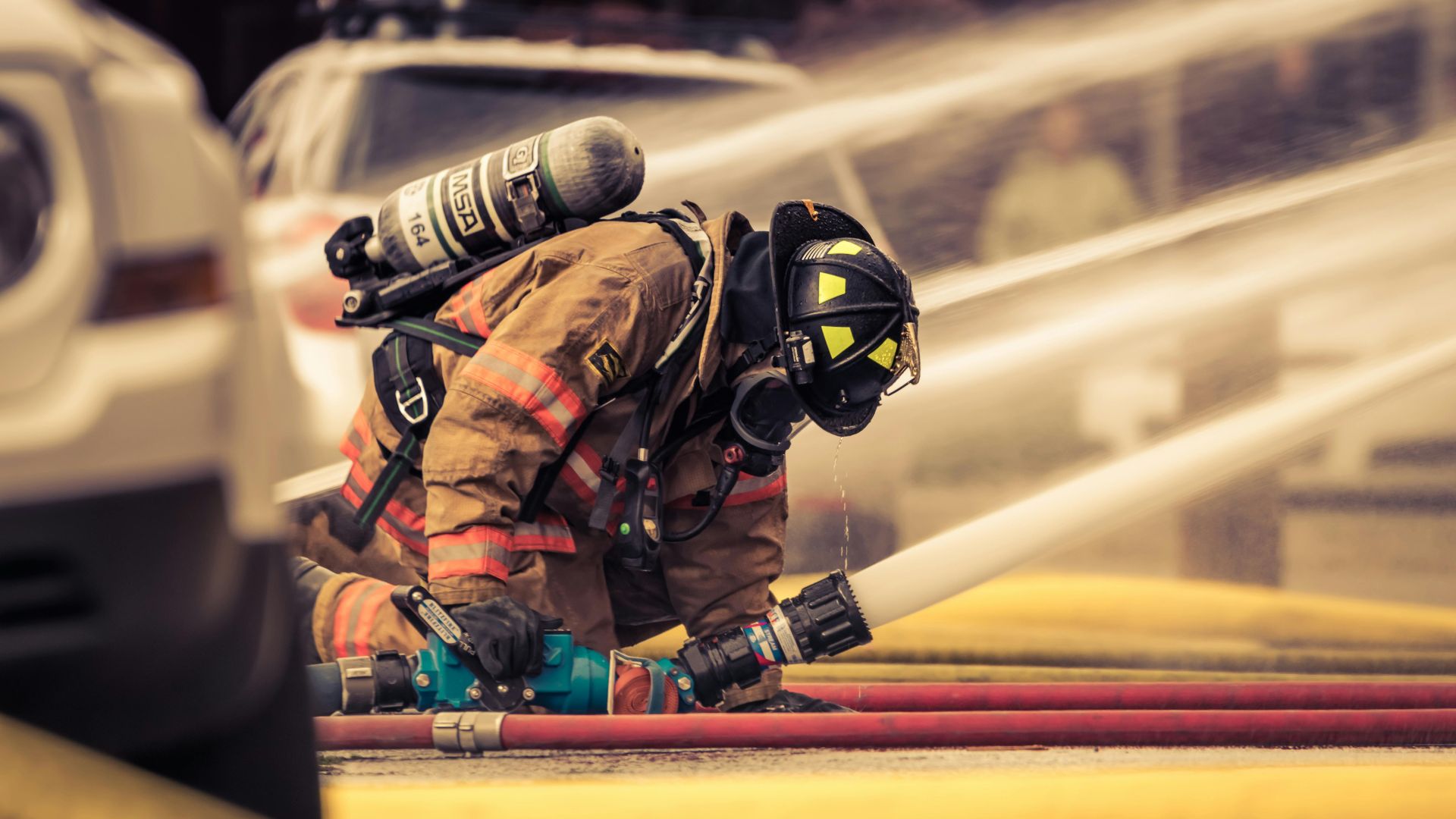
Electric vehicles were supposed to be the clean, quiet future of transportation. Nobody in the early days of the EV boom spent much time thinking about what happens when one catches fire. Now, as battery-powered cars move from novelty to mainstream, fire departments across the country are scrambling to answer a question that turns out to be surprisingly complicated: how do you put out a fire that doesn't want to go out?
The short answer is that you might not be able to, at least not quickly. EV fires, particularly those involving lithium-ion battery packs, behave in ways that conventional firefighting training simply doesn't cover. The tactics that work on a gasoline-fed engine fire can be almost useless against a battery in thermal runaway. Understanding why takes us into some genuinely strange chemistry, and into a training gap that fire departments are only now starting to close.
What Thermal Runaway Actually Means
The term gets thrown around a lot, but it describes something specific and alarming. When a lithium-ion cell is damaged, overcharged, or subjected to extreme heat, it can enter a self-sustaining chain reaction where each failing cell heats the cells next to it, which then fail in turn. The process generates its own oxygen, which is why smothering the fire with foam or cutting off air supply, the go-to moves for many fire types, don't work the way you'd expect.
According to the National Fire Protection Association, water is still the most effective suppression agent for lithium-ion battery fires, but the volumes required are staggering. A 2020 report from the NFPA found that extinguishing an EV fire can require between 3,000 and 8,000 gallons of water, compared to roughly 300 gallons for a typical gasoline vehicle fire. Some incidents have required far more. A Tesla Model S fire in Florida in 2018 reportedly required firefighters to use approximately 30,000 gallons before the vehicle stopped reigniting.
That reignition problem is the part that catches people off guard. A battery pack can appear fully extinguished, cool to the touch on the outside, and still have cells deep inside that are hot enough to restart combustion hours or even days later. Several fire agencies now recommend storing burned EVs in water-filled containers or submerging them in dumpsters full of water for 24 hours or more after a fire, a solution that sounds almost absurdist until you understand the physics behind it.
The Training Gap Fire Departments Are Racing to Close
Most career firefighters in the United States were trained on combustion chemistry that assumes a fuel source and an oxidizer that can, at least in theory, be separated. Lithium-ion batteries upend that model, and the training infrastructure hasn't kept pace with the technology. A 2022 survey by the Fire Department Safety Officers Association found that fewer than 30 percent of fire departments had received any formal training specific to EV fires.
Several organizations are working to change that. The NFPA launched its Electric Vehicle Safety Training program in partnership with the Department of Energy, and as of 2023, it has reached tens of thousands of first responders. The program covers not just suppression tactics but also the high-voltage hazards that come with cutting into a vehicle during a rescue operation. EV battery packs operate at voltages between 400 and 800 volts in most consumer vehicles, and the cables that carry that current don't always look the way firefighters expect them to.
Automakers have started contributing to the effort, partly out of liability concerns and partly out of genuine interest in seeing their vehicles handled safely. Tesla, GM, and Ford have all published emergency response guides for their vehicles, and some departments have begun running tabletop exercises using those documents. The challenge is that battery architectures vary significantly between manufacturers, so what works for one vehicle may not apply to another. Firefighters are essentially learning a new curriculum for each major platform.
Why This Matters Beyond the Fire Station
EV adoption in the United States is accelerating. The Department of Energy reported that EV sales in 2023 topped 1.2 million units, a 40 percent increase over the prior year. As more of these vehicles end up on roads, in parking garages, and in home garages, the probability of fire departments encountering battery fires in complex environments goes up accordingly. A thermal runaway event in an enclosed parking structure is a categorically different problem than one on an open highway.
The good news is that EV fires are still relatively rare on a per-vehicle basis. The Swedish Civil Contingencies Agency published data in 2022 suggesting that EVs catch fire at lower rates than gasoline vehicles. The challenge isn't frequency, it's severity and duration when fires do occur. Fire departments don't need to treat every EV as a hazard, but they do need to know what they're dealing with when one goes wrong. That knowledge, right now, is unevenly distributed, and the gap between departments that have it and departments that don't is one worth closing fast.