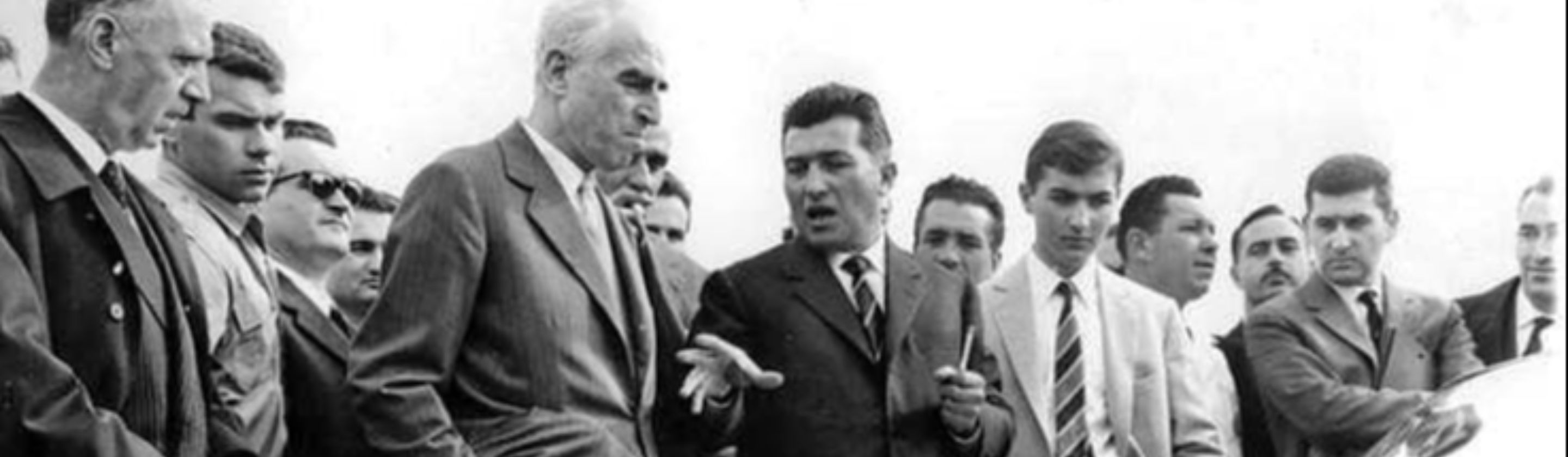
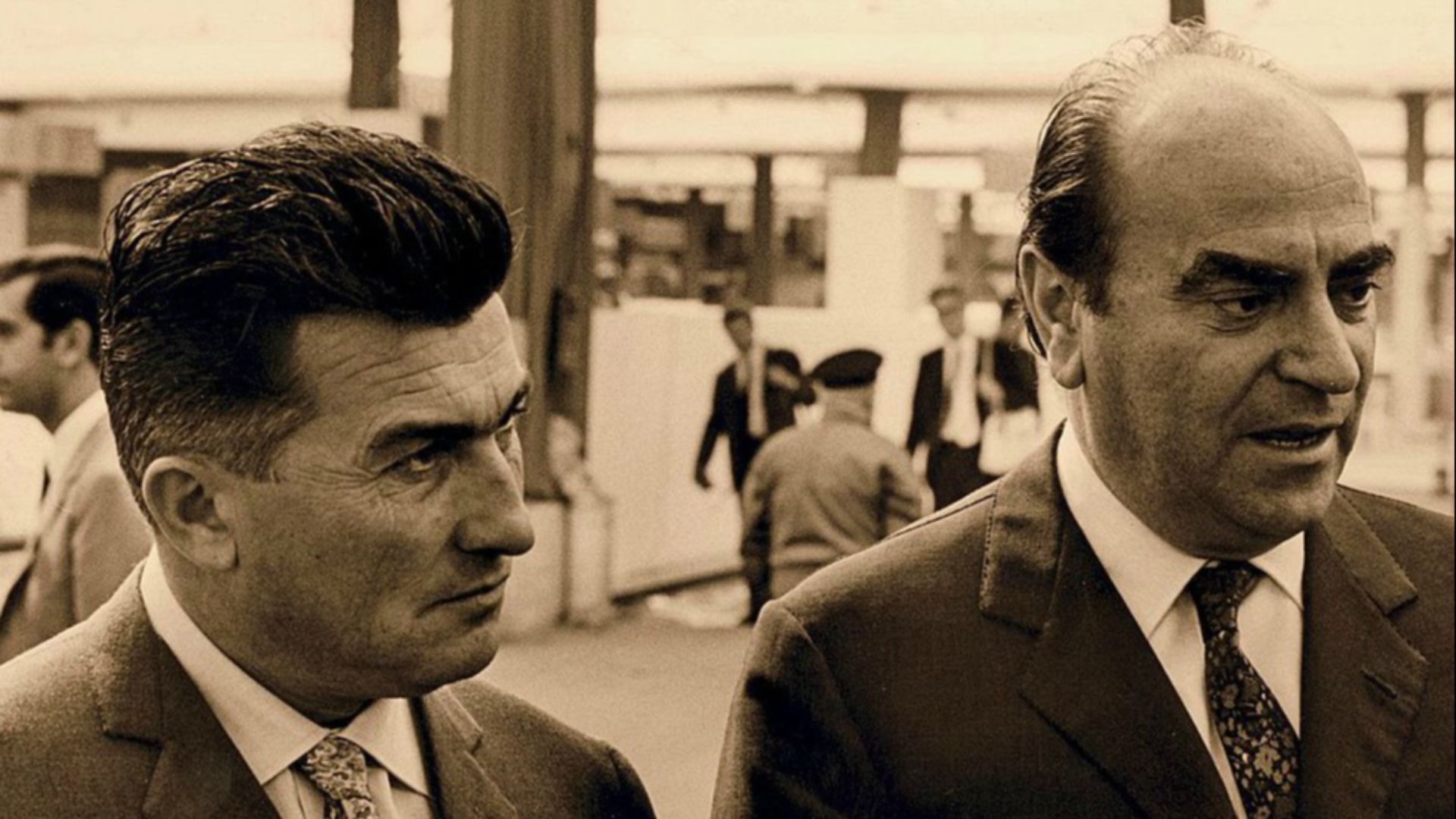
 Unknown photographer on Wikimedia
Two factories sit about 20 miles apart in the flat farmland of Emilia-Romagna, close enough that workers have moved between them for decades. One is in Maranello, where Enzo Ferrari started building cars in 1947. The other is in Sant'Agata Bolognese, where Ferruccio Lamborghini set up shop 16 years later with a grudge and a lot of tractor money.
The argument that put the second factory there lasted a few minutes. What came out of it was the modern supercar, a category that barely existed before these two spent a decade trying to embarrass each other. Nearly every mid-engine exotic on the road today descends from that quarrel.
Tractors and Race Cars
Ferruccio Lamborghini trained as a mechanic and spent the war keeping vehicles running for the Italian air force. He came home to a country short on everything and started building tractors out of surplus military parts. That became Lamborghini Trattori. Heating and air conditioning made him richer still, and by his forties he could buy whatever car he wanted.
He wanted Ferraris. Enzo Ferrari had spent the 1950s winning at Le Mans and in Formula One, and his road cars mostly existed to fund the racing team. That priority showed in the driving. The cars were loud and stiff, built by people who cared more about lap times than about a comfortable trip to Milan.
Lamborghini owned several of them and kept finding fault. According to longtime Lamborghini test driver Valentino Balboni, quoted in a Discovery UK piece on the rivalry, Ferruccio was hard on clutches and grew tired of sending the car back to the factory. He eventually had his own mechanics pull the transmission apart to see what was inside.
The Argument
What he found, by the most repeated version of the story, was a clutch he recognized from his own tractor supply shelf. He took the complaint to Maranello himself, which was not how Ferrari customers usually behaved. Enzo Ferrari reportedly told him to stick to tractors and leave the cars alone.
Accounts differ on where the meeting happened and whether it happened at all, yet every version ends the same way: he decided to build a better grand tourer himself.
He founded Automobili Ferruccio Lamborghini in May 1963 and hired from his rival's talent pool. Giotto Bizzarrini, who had worked on the Ferrari 250 GTO, designed the V12. Gian Paolo Dallara took the chassis, and a New Zealander named Bob Wallace handled testing. The 350 GTV prototype appeared at the Turin show that October, roughly six months after the company existed on paper. Bizzarrini reportedly got a bonus for every horsepower the engine made over Ferrari's.
Sixty Years of Answering Back
The 350 GT that followed in 1964 was exactly what Ferruccio said he wanted, which was a fast car you could drive to dinner. Then his team went further. The Miura, shown as a bare chassis in 1965 and with its body in 1966, put a V12 sideways behind the driver and gave the industry a template it has been copying ever since. Ferruccio had asked for a comfortable tourer, and his engineers handed him the car that ended up on a million bedroom walls in poster form.
Maranello answered in 1968 with the Daytona, its engine still up front. Five years later came the mid-engine Berlinetta Boxer. By then Lamborghini had already launched the Countach, which arrived as the LP500 prototype at Geneva in 1971. The scissor doors and the wedge profile came from that same argument about a clutch.
Ferrari sold half his company to Fiat in 1969 and remained involved on the racing side until his death in 1988. Ferruccio sold his controlling stake in 1972 after a tractor deal with Bolivia collapsed, let the rest go in 1974, and spent his later years making wine at an estate in Umbria. Their two factories still sit 20 miles apart, and the badge on the hood still decides which side of that road you're on. Both companies now belong to German parents, and neither has stopped keeping score.