 commons.wikimedia.org on Google
When the STP-Paxton Turbocar rolled out at Indianapolis in May 1967, the sound was the first thing anyone noticed. Thirty-two other cars sat there making the noise everyone expected from a race car. The turbine made a rising whoosh instead, and the car picked up the nickname Silent Sam from people who couldn't hear it coming.
The car then led 171 of the 200 laps and lost the race to a part worth about six dollars. Nothing in the fifty-plus years since has come that close to ending piston engines at the Speedway.
A Turbine Where The Engine Should Be
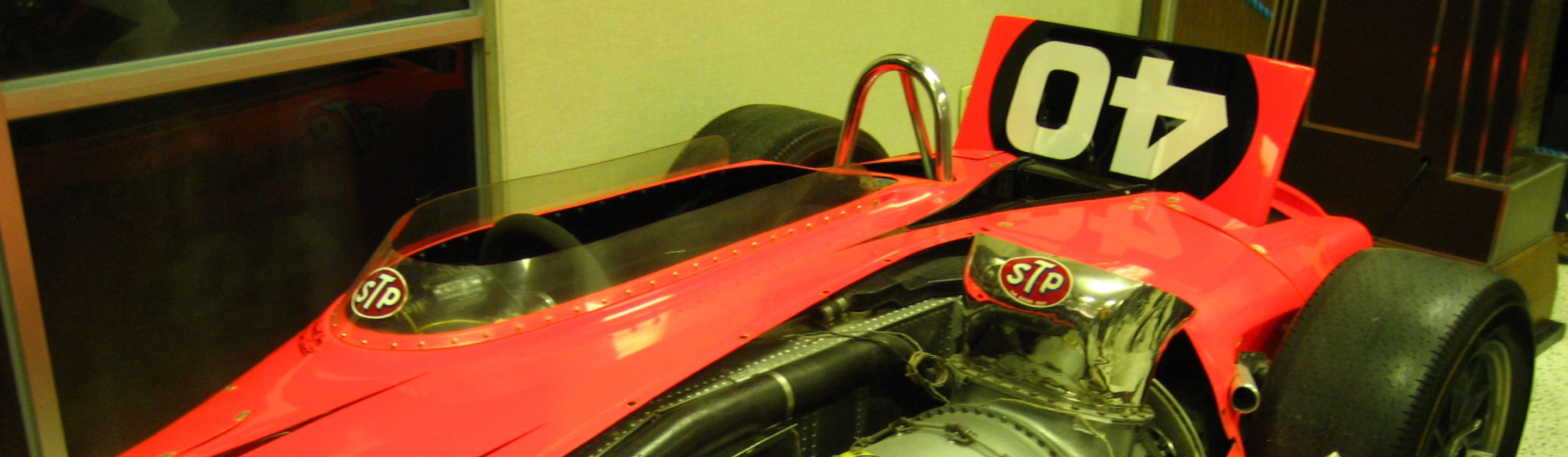
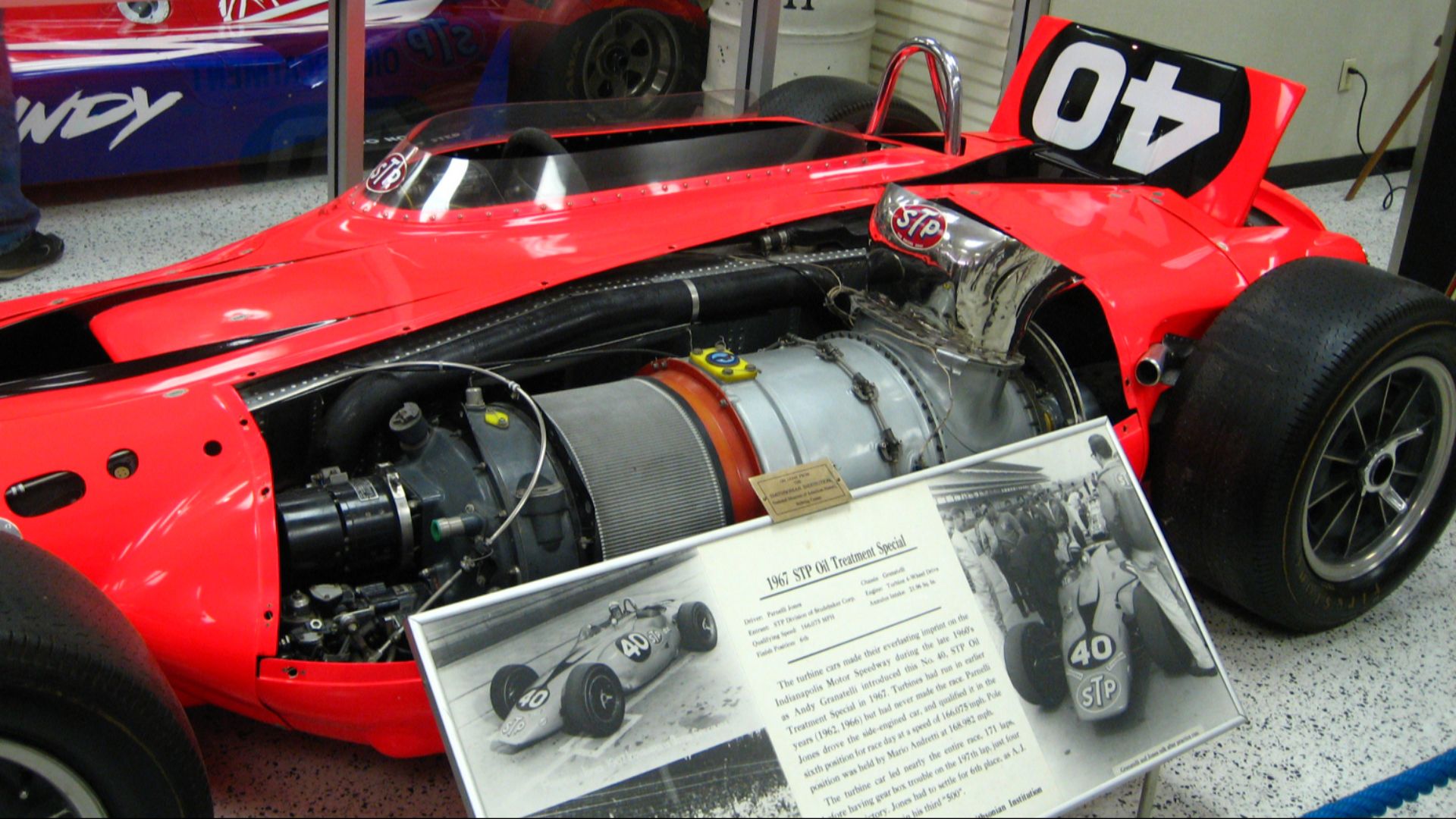
Under the bodywork sat a Pratt and Whitney ST6, a turbine of the type normally found in helicopters rather than on an oval. It made more than 550 horsepower, and it made it in a way nothing else in the field did, with no pistons rising and falling and no powerband to work around. The driver had one pedal to think about and a wall of torque available from anywhere.
The layout was stranger than the engine. A central backbone frame carried the turbine on the left and the cockpit on the right, so the driver sat beside his engine rather than ahead of it. Power went to all four wheels through a single-speed torque converter, which meant no gearbox in the usual sense and no shifting at all.
The idea came from engineer Ken Wallis, who shopped it to Dan Gurney and Carroll Shelby before finding anyone willing to fund it. Both of them passed on it. Andy Granatelli, who ran STP and had a long history of turning up at Indianapolis with something nobody had asked for, said yes and had the car on the grid within a year.
Dominant, Then Stopped
Parnelli Jones qualified at 166.075 mph for the sixth starting spot and then made the race look like an exhibition. He took the lead on the opening lap and was never worse than third all afternoon, leading 171 of the 200 laps. Four-wheel drive let him carry speed through the corners that the rear-drive roadsters could not, so the usual business of defending a position never really came up.
With three laps remaining he held a 52-second lead over A.J. Foyt. Then a bearing in the gearbox failed, and Jones coasted the car down toward the pit entrance and climbed out while Foyt went by to win his third 500. The bearing cost six dollars.
There's a theory about when it broke. The car had made a late pit stop, and the suspicion is that the bearing let go when Jones accelerated hard getting back out onto the track. A turbine delivers its power instantly and without mechanical sympathy, which is a problem if the parts behind it were specified for something gentler. The car had done everything asked of it for roughly 490 miles, and the component that gave out was the kind of thing a hardware store sells out of a drawer.
The Rules Caught Up Faster Than The Cars
Turbines were legal in 1967 and the subject of immediate objection. Rival teams argued the engine fell outside the spirit of the formula, and the sanctioning body agreed to act before the next race. For 1968 the sanctioning body cut the allowable air intake size, which is the direct way to strangle a turbine, and teams built turbine cars anyway. STP, Lotus, and Shelby all showed up with them.
The 1968 race went almost exactly the same way. Joe Leonard, driving a Lotus 56 with a Pratt and Whitney turbine making around 500 horsepower, led from lap 175 to lap 192. A fuel delivery failure stopped him with eight laps to go, while he was still in front, and Bobby Unser won in a piston-engined car. Two years running, a turbine led late and did not finish.
That was the end of the argument. Turbine engines and four-wheel drive were both legislated out, and by 1969 the rules had made the whole concept noncompetitive at Indianapolis. Nothing about the engines had been disproven, since neither turbine car was beaten on the track by a faster car. The Turbocar itself survived and belongs to the Smithsonian now, which is a reasonable place for a car that spent one afternoon three and a half laps away from making every other engine in American racing obsolete.